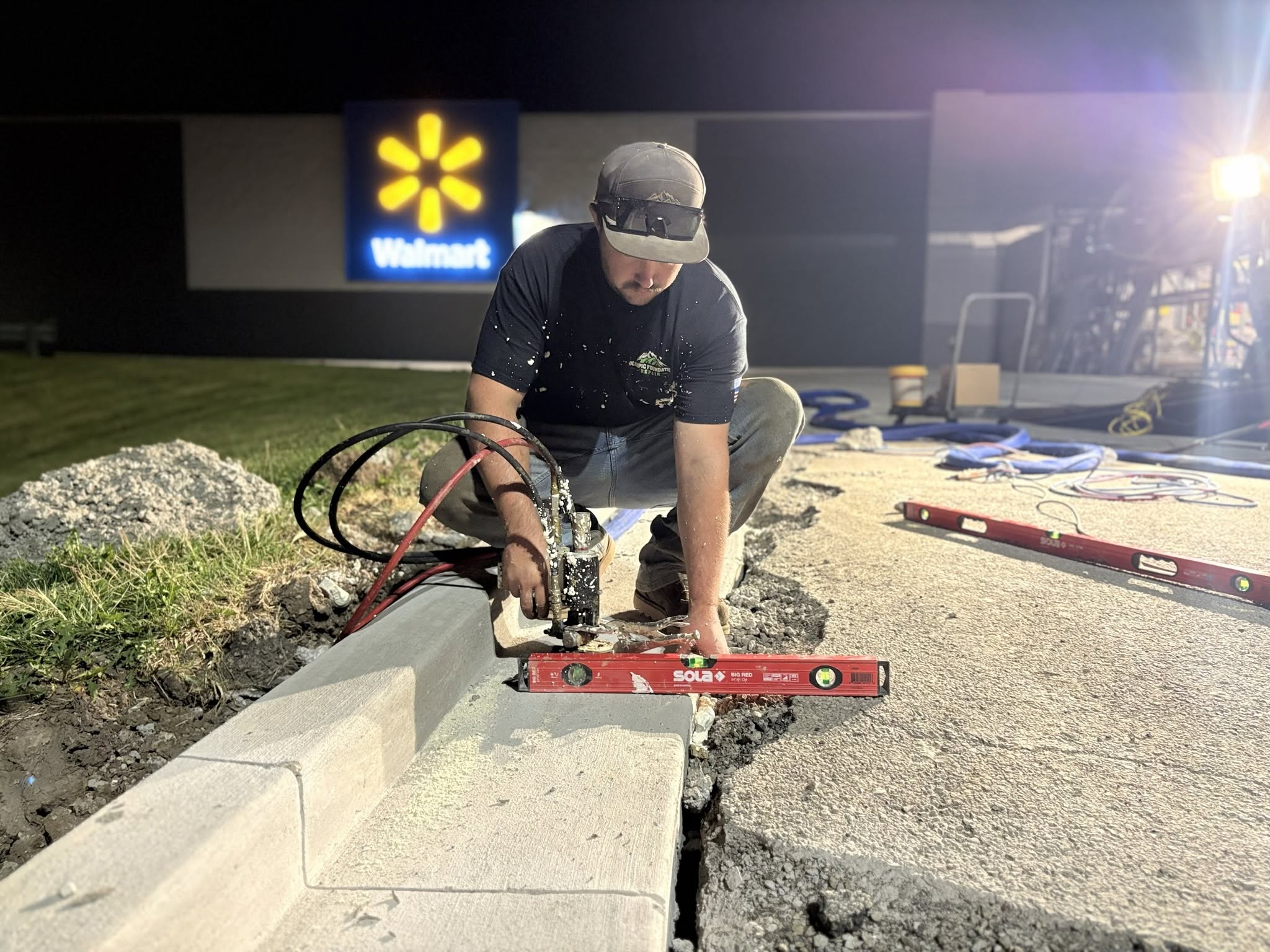
Concrete Curb Lifting Specialists
Olympic Concrete Lifting provides professional concrete curb lifting and stabilization for commercial properties, apartment communities, HOAs, municipalities, parks, retail centers, and other properties throughout the Kansas City area.
When curbs settle, they can create uneven transitions, affect drainage, and leave otherwise usable concrete sitting below the surrounding surface. Polyjacking can often raise and stabilize structurally sound curb sections without the demolition and reconstruction required for complete replacement.
Restore Settled Curbs Without Starting Over
Concrete curbs depend on the soil and base material beneath them just like sidewalks, driveways, and other slabs. Over time, erosion, poor drainage, soil settlement, or inadequate compaction can cause portions of a curb to sink or shift.
Because curbs often connect parking areas, sidewalks, landscaping, and drainage paths, even localized settlement can affect more than appearance. A low curb section may change how water moves, create awkward transitions, or leave gaps between neighboring surfaces.
Concrete leveling & polyjacking can restore support beneath qualifying curb sections and carefully raise them toward the proper elevation while preserving the existing concrete.
Where Curb Settlement Creates Problems
Parking Lot Edges
Drainage Paths
Sidewalk & Pedestrian Transitions
Landscaped Areas
Why Curb Elevation Matters
Curbs are not only decorative borders. They can help define traffic areas, separate surfaces, support drainage patterns, and create transitions between parking lots, sidewalks, landscaped areas, and other concrete.
When a curb settles, the surrounding surfaces may remain in place while the curb itself drops. That can leave the section looking out of alignment and may interfere with how the surrounding area was designed to function.
Olympic Concrete Lifting evaluates the curb together with nearby pavement, drainage, sidewalks, and landscaping before determining whether lifting is appropriate.
Benefits of Concrete Curb Lifting
When the existing curb is still structurally sound, lifting can provide a practical alternative to removing and rebuilding the entire section. Polyurethane foam works beneath the concrete to restore support while allowing the curb itself to remain in place.
Preserve Existing Curbs
Structurally sound concrete can often be lifted rather than demolished simply because the supporting soil has settled.
Improve Drainage
Correcting low sections may help restore intended surface slopes and improve how runoff moves along the curb line.
Restore Transitions
Lifting can improve areas where curbs meet sidewalks, pavement, ramps, and other concrete surfaces.
Minimize Disruption
Polyjacking generally requires less demolition, debris, and curing time than removing and replacing a curb section.
Stabilize Lost Support
Expanding polyurethane foam fills empty spaces beneath the concrete and helps restore support where soil has moved or eroded.
Improve Appearance
Straight, consistent curb lines help commercial and community properties look cleaner and better maintained.
Curb Lifting vs. Replacement
Lift the Existing Curb
When the concrete remains in good condition, polyurethane foam can fill voids and raise a settled section while preserving the existing curb.
Replace the Curb
Concrete that is badly broken, deteriorated, displaced, or no longer structurally sound may be better suited for removal and replacement.
The goal is to preserve usable concrete where it makes sense—not to lift every curb regardless of condition.
Our Concrete Curb Lifting Process
Evaluate the Curb
We inspect the settled section, surrounding pavement, drainage, nearby slabs, and signs that support has been lost.
Plan the Correction
Injection locations and the desired elevation are determined based on how the curb connects with surrounding surfaces.
Lift & Stabilize
Polyurethane foam is injected beneath the curb to fill voids, restore support, and carefully raise qualifying sections.
Review the Transition
The repaired curb is checked against adjacent pavement, sidewalks, landscaped areas, and drainage paths.

Where Curb Lifting Is Commonly Used
Retail & Office Properties
Apartment Communities
HOA Common Areas
Municipal & Park Properties
Commercial Facilities
When the Problem Extends Beyond the Curb
Curb settlement can sometimes be part of a larger concrete issue.
The adjoining sidewalks may also be uneven, nearby ramps & walkways may have shifted, or runoff may have created empty spaces beneath the curb and surrounding slabs. In those situations, void filling or additional concrete lifting may be needed to restore support throughout the area.
If the curb or adjoining concrete is cracked or deteriorated, concrete repair may also be appropriate.
Drainage, Erosion & Curb Settlement
Curbs are often positioned where water naturally travels across parking lots, streets, and landscaped areas. When runoff moves repeatedly along or underneath the concrete, soil can gradually erode and leave portions of the curb unsupported.
That loss of support can cause the curb to drop while neighboring surfaces remain relatively stable. Correcting the elevation may help restore the curb line, but the surrounding drainage conditions should also be considered so the repair addresses more than the visible symptom.
Concrete Curb Lifting FAQs
What causes concrete curbs to sink?
Curb settlement can result from soil compression, erosion, poor compaction, drainage, moisture changes, or voids that develop beneath the concrete.
Can curbs be lifted instead of replaced?
Often, yes. Structurally sound curb sections may be candidates for concrete leveling & polyjacking when settlement beneath the concrete is the primary problem.
Can curb lifting help with drainage?
If settlement has changed the curb elevation or surrounding slope, lifting may help restore the intended surface relationship. Drainage conditions should still be evaluated as part of the project.
Can curbs be lifted next to asphalt?
Potentially. The condition and elevation of the curb, pavement, and surrounding surfaces need to be evaluated before determining the repair approach.
What if there is a void beneath the curb?
Polyurethane foam can fill empty spaces during the lifting process. Areas that primarily need support may benefit from void filling.
Can damaged curbs still be lifted?
Minor damage does not automatically rule out lifting, but severely broken or deteriorated sections may need concrete repair or replacement.
Can sidewalks and curbs be lifted together?
Yes. If nearby sidewalks have also settled, Commercial Sidewalk Lifting can be evaluated along with the curb as part of the same project.
Do you lift curbs at commercial and municipal properties?
Yes. Olympic Concrete Lifting works with retail properties, offices, apartment communities, HOAs, municipalities, parks, industrial facilities, and other commercial sites.