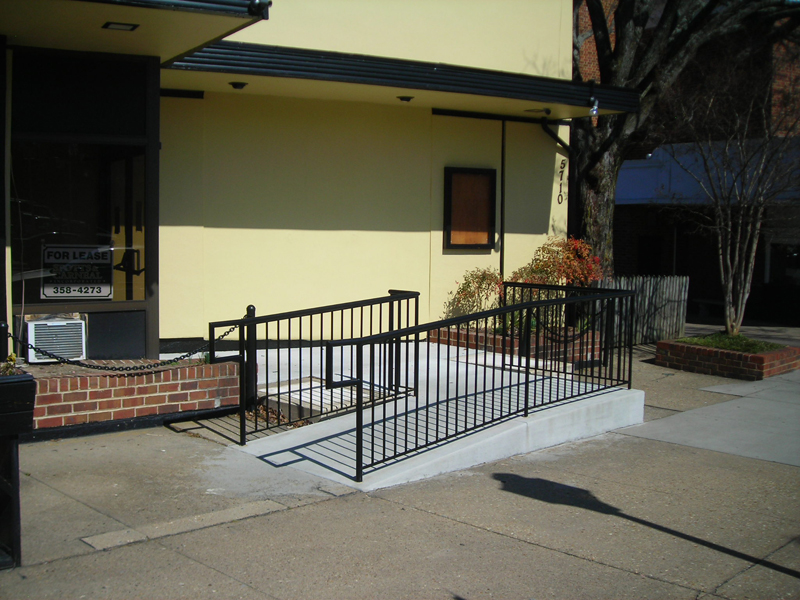
Concrete Ramp & Walkway Lifting Specialists
Olympic Concrete Lifting provides professional concrete ramp and walkway lifting for commercial properties, apartment communities, HOAs, parks, offices, retail centers, and other high-traffic environments throughout the Kansas City area.
When ramps or walkways settle, even relatively small elevation changes can create awkward transitions, drainage problems, and uneven walking surfaces. Polyjacking can often restore structurally sound concrete without the disruption of tearing out and replacing the entire slab.
Restore Smooth, Functional Pedestrian Routes
Ramps and walkways are designed to create consistent paths between entrances, parking areas, sidewalks, buildings, and shared spaces. When sections settle at different rates, those transitions can become uneven and harder to navigate.
Soil settlement, erosion, drainage, and loss of support beneath the slab can all contribute to movement. In many cases, concrete leveling & polyjacking can lift the affected concrete while preserving the original surface.
For areas where the slab has not significantly moved but has lost support underneath, void filling may be used to stabilize the concrete before more noticeable settlement occurs.
Where Problems Usually Develop
Ramp Transitions
Walkway Joints
Building Entrances
Drainage Areas
Benefits of Ramp & Walkway Leveling
Ramps and walkways are used constantly, which makes smooth transitions and stable support especially important. Concrete lifting can correct settlement while allowing existing slabs to remain in place when the concrete itself is still in good condition.
Improve Walking Surfaces
Correcting uneven slab transitions helps create smoother pedestrian routes around entrances, shared spaces, and commercial properties.
Restore Transitions
Lifting can improve areas where ramps, sidewalks, and walkways no longer meet surrounding surfaces at the intended elevation.
Improve Drainage
Settlement can alter the way water moves across a walkway or ramp. Correcting the slab position may help restore more appropriate surface drainage.
Reduce Disruption
Polyjacking requires less demolition and curing time than full replacement, helping minimize interruptions around active properties.
Preserve Existing Concrete
Structurally sound ramps and walkways can often be lifted instead of being removed simply because the soil beneath them has settled.
Stabilize the Slab
Polyurethane foam fills voids beneath the concrete and helps restore support in areas where soil has shifted or washed away.
Why Ramps Require Extra Precision
Unlike a flat slab, a concrete ramp is intentionally built with a slope. The goal of lifting is not simply to make the slab “level,” but to correct settlement while maintaining the way the ramp transitions between surrounding surfaces.
That makes careful evaluation especially important. The ramp, adjoining sidewalks, entrance elevations, drainage, and the amount of movement all need to be considered before deciding how the concrete should be adjusted.
Olympic Concrete Lifting evaluates the entire transition before lifting so the repair is based on the function of the ramp—not just the position of one corner.
Lifting Ramps vs. Walkways
Concrete Ramps
Ramp settlement can affect the grade, transitions, drainage, and how the slab connects to neighboring surfaces. Lifting needs to account for the intended slope of the concrete.
Concrete Walkways
Walkways are often made up of multiple individual slabs. When one section settles more than the next, uneven joints and raised edges can develop along the pedestrian route.
Both surfaces depend on stable support underneath them, and both may benefit from polyurethane lifting when the existing concrete remains structurally sound.
Our Ramp & Walkway Lifting Process
Evaluate the Route
We inspect the concrete, elevation changes, adjoining slabs, drainage, and areas where support may have been lost.
Plan the Correction
Injection locations and the amount of lift are planned around the intended slope and surrounding transitions.
Lift & Stabilize
Polyurethane foam is injected beneath the slab to fill voids, restore support, and carefully adjust settled areas.
Review the Transitions
The repaired area is checked against neighboring concrete to confirm that the walkway or ramp is functioning as intended.
Where Ramp & Walkway Lifting Is Used
Retail & Office Properties
Apartment Communities
HOA Common Areas
Municipal & Park Properties
Commercial Facilities
When More Than Lifting Is Needed
Settlement may not be the only issue affecting a ramp or walkway.
Some slabs may also have cracks, deteriorated edges, worn joints, or years of surface buildup. Olympic Concrete Lifting can combine lifting with concrete repair, joint sealing, or power washing where appropriate to provide a more complete restoration.
If the concrete is severely deteriorated or structurally damaged, replacement may make more sense than lifting. The goal is to preserve existing concrete when it is practical—not to force every slab into the same repair.
Ramp & Walkway Concrete Lifting FAQs
What causes concrete ramps and walkways to settle?
Settlement can result from soil compression, erosion, poor compaction, drainage, moisture changes, and voids that develop beneath the slab.
Can a concrete ramp be lifted without changing its slope?
The goal is to correct unwanted settlement while accounting for the ramp’s intended slope and surrounding transitions. Every ramp needs to be evaluated individually before lifting.
Can uneven walkways be lifted instead of replaced?
Often, yes. Structurally sound slabs may be candidates for lifting when settlement beneath the concrete is the main problem.
Can polyjacking help with trip hazards between walkway slabs?
If the elevation difference is caused by settlement, concrete leveling & polyjacking may be able to raise the lower slab and improve the transition.
What if there are voids beneath the walkway?
Polyurethane foam fills voids as part of the lifting process. Concrete that has lost support without significant settlement may also benefit from dedicated void filling.
Can cracked ramps or walkways still be lifted?
Possibly. Minor cracking does not automatically prevent lifting, but damaged areas may also require concrete repair depending on the slab’s condition.
Can you lift ramps and walkways at active commercial properties?
Yes. Polyjacking generally creates less demolition and downtime than full replacement, making it useful for many active commercial and multifamily properties.
Can joint sealing be done after lifting?
Yes. If the joints also need attention, joint sealing can be completed as part of a broader concrete restoration plan.